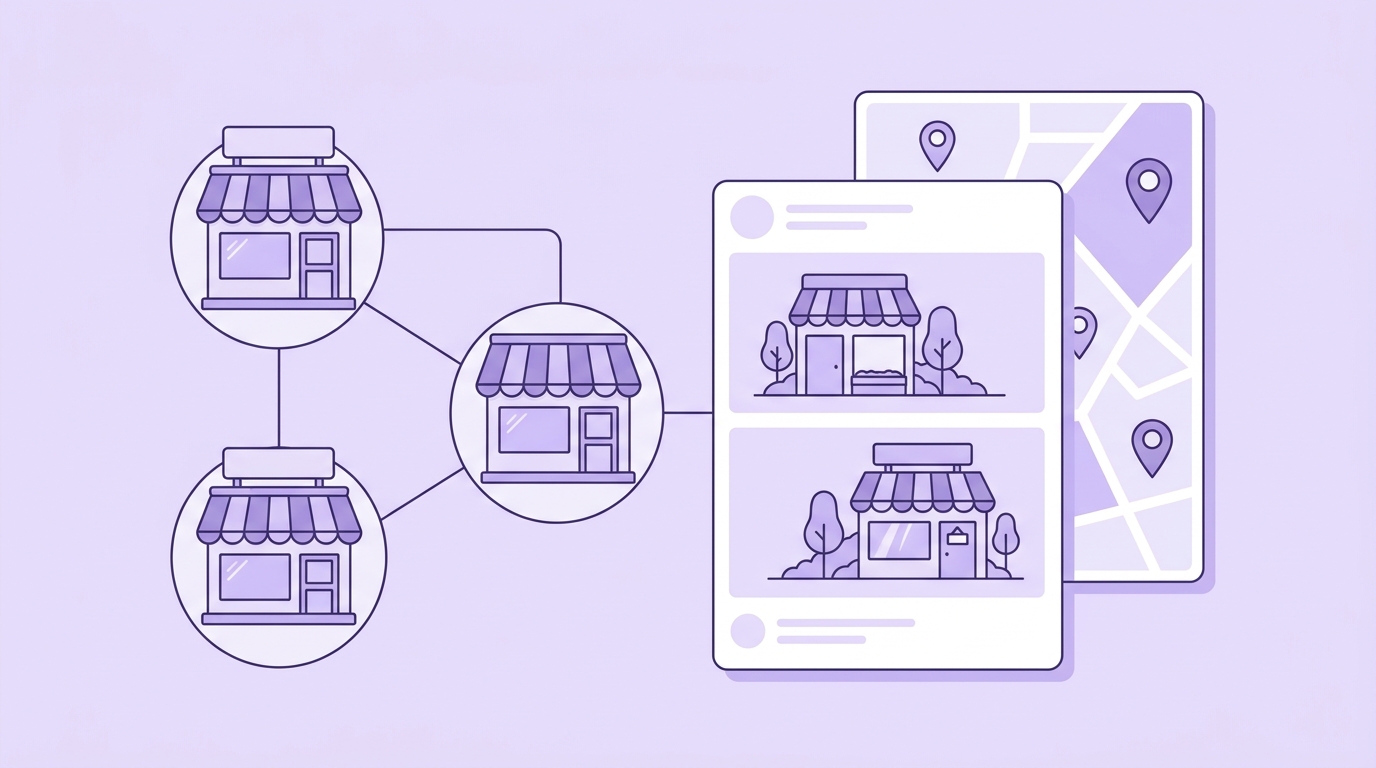
Franchise marketing has one central challenge: customers should recognize the brand wherever they encounter it, while each location still needs to be relevant to its community.
That is not a choice between control and local creativity. It is a shared operating model. The franchisor defines the promise, standards, and guardrails. The franchisee applies them with local knowledge, then sends what they learn back into the system.
This guide covers the practical work: campaign planning, local search, social media, email, paid media, reviews, governance, and measurement. It focuses on operational marketing for customer acquisition and retention, not on recruiting prospective franchisees.
What is a franchise?
A franchise is a business arrangement in which a franchisor licenses a brand, operating system, and other rights to a franchisee. The specific rights, fees, support, obligations, territory, and marketing requirements are defined by the agreement and applicable law.
In the United States, the FTC Franchise Rule requires franchisors to provide prospective franchisees with a disclosure document containing 23 specified items of information. That rule addresses disclosure, not every operational decision a franchise system will make. Franchise agreements and state, national, and local laws vary, so obtain legal advice for the jurisdictions in which you operate.
Franchisor and franchisee roles
A franchisor typically owns or controls the brand and defines the operating system. A franchisee operates a location or territory under that system. The split is not identical in every network, but customer-facing marketing usually works best when responsibilities are explicit:
- Franchisor: brand positioning, required claims and disclosures, approved creative, core campaigns, shared technology, training, and system-level reporting.
- Franchisee: local execution, local community knowledge, location details, customer service, approved local partnerships, and feedback from the market.
- Shared: campaign planning, content adaptation, issue escalation, performance review, and the decision to retire or scale a tactic.
Operational marketing vs. franchise development marketing
Operational franchise marketing reaches customers for existing locations. It may include location pages, local search, social content, email, events, paid advertising, promotions, and customer communications.
Franchise development marketing reaches people who may want to buy a franchise. It has different audiences, disclosures, risk considerations, and conversion steps. Do not reuse customer-facing claims or financial language for franchise recruitment without appropriate review.
Why coordination is the foundation
A franchise network has two audiences at once: customers who need a useful local experience and franchisees who need a practical system they can apply. A national campaign that cannot be used locally will be ignored. Local activity that departs from the brand can confuse customers and create compliance risk.
Start by agreeing on the elements that cannot change:
- The customer promise and the evidence that supports it.
- Required visual identity, tone, legal language, and offer terms.
- Who can approve, publish, pause, or correct marketing activity.
- How customer questions, complaints, safety concerns, and media inquiries are escalated.
- Which location details must be accurate everywhere: name, address, phone number, hours, services, and booking or ordering links.
Then document what can vary by location: local imagery, community events, staffing, inventory, language, seasonal needs, neighborhood references, and location-specific offers that meet the system's rules.
Build the operating model before the campaign
1. Set one decision-ready objective
State what the campaign is meant to do and for whom. Examples include generating qualified appointment requests for locations with availability, introducing a new local service, encouraging existing customers to return, or increasing attendance at a local event.
Choose one primary measure and a small set of supporting measures. For an appointment campaign, the primary measure may be completed appointment requests, with phone calls, directions requests, and landing-page engagement as supporting measures. Do not label a vanity metric as success if the business decision depends on a different behavior.
2. Assign responsibilities
Create a simple responsibility table for each campaign: who provides the brief, who adapts creative, who checks local facts, who approves claims, who publishes, who handles replies, and who reports results. The table matters most when a campaign changes quickly or something goes wrong.
A franchisor should not have to approve every routine local post. A franchisee should not have to guess whether an offer, a testimonial, or a partnership is permitted. Define the categories that need central approval and give locations a safe path for routine execution.
3. Create reusable assets and rules
Give locations a current campaign kit rather than a static brand PDF. A useful kit includes approved messages, editable templates, image guidance, offer terms, landing-page links, UTM naming rules, optional local copy blocks, publication dates, and an escalation contact.
Version the files and retire old offers. If a location downloads a dated discount, expired claim, or old logo, the problem is usually a system problem before it is a location problem.
4. Plan the feedback loop
Ask each location to report what customers asked, which objections came up, whether the offer could be fulfilled, and where the campaign created friction. Central teams can use that feedback to improve the next kit. Locations are not just distribution points; they are a source of customer insight.
How to plan and run a franchise campaign
Step 1: Set the goal, budget, and constraints
Set the campaign's customer, offer, geographic scope, start and end dates, spend owner, fulfillment capacity, and primary measure. Confirm that each participating location can deliver the promoted experience before it goes live.
Separate central and local budgets where possible. This makes the investment and the decision rights visible. It also prevents a location from being judged against a campaign it could not control or fulfill.
Step 2: Define the brand and local requirements
Put the non-negotiables in the brief: logo usage, required wording, prohibited claims, disclosure requirements, destination URLs, response standards, and offer terms. Put the local choices in a separate section: approved local proof points, city or neighborhood references, local images, event details, and calls to action.
Use plain language. A rule such as "do not make unsubstantiated performance claims" is more useful when paired with examples of permitted and prohibited wording.
Step 3: Select channels based on the customer task
Do not choose channels because every location is expected to use them. Match the channel to the task:
- Local search and location pages: help people find an address, hours, services, directions, or booking details.
- Social media: show local activity, answer questions, support community relationships, and distribute approved campaign content.
- Email or SMS: communicate with people who have given the required permission and need relevant local information.
- Paid media: reach a defined audience for a time-bound offer, event, or service when the location can track and fulfill the response.
- Events and partnerships: create a local reason to engage when the partner, audience, and follow-up path are clear.
- Customer stories and user-generated content: show real experiences only when you have the necessary permission and disclosures.
Step 4: Publish, monitor, and adjust
Launch with a checklist: the local details are correct, offer terms match the destination page, tracking is present, response owners are available, and the location can serve people who respond. Monitor for broken links, incorrect hours, customer confusion, stock or capacity limits, and comments that need escalation.
Change a live campaign deliberately. Record what changed, where it changed, and why. Otherwise, later reporting may compare different offers or audiences as if they were the same test.
Use local search as an accuracy project
For many franchise customers, the first question is practical: where is the nearest location, when is it open, and can it provide the service I need? Treat this information as a maintained product, not a one-time marketing task.
Google says local results are mainly based on relevance, distance, and prominence. Its current guidance also says complete and accurate Business Profile information can help a business appear in relevant local results, while no one can request or pay for a better local ranking. Read Google's local-ranking guidance for the current details.
For every location, establish an owner and a recurring check for:
- Business name, address, phone number, hours, special hours, category, website, and booking or ordering links.
- A unique, useful location page with service information that is true for that location.
- Clear ownership of the Google Business Profile and other important listings.
- Location-specific photos and service details that customers can verify.
- Consistent data across the franchise website, profiles, directories, and campaigns.
If the website supports it, define each location with LocalBusiness structured data that matches the visible page. Google describes the markup as a way to provide details such as hours and departments; it does not guarantee a particular search appearance or ranking.
Social media: central standards, local proof
Social media becomes difficult in a franchise network when the central team treats locations as a broadcast channel, or when locations treat the brand account as a blank canvas. The answer is a shared workflow.
Build a central calendar for campaigns, product launches, seasonal moments, and required messages. Give locations a library of approved posts they can use as-is or adapt within defined boundaries. Require an approval only when the post introduces a new claim, price, partnership, contest, sensitive topic, or customer story.
Local teams can add the details that central teams cannot know: a staff introduction, a local event, a change in hours, a community partnership, or an answer to a repeated customer question. Keep the tone and promise consistent, but do not force every location to sound identical.
A shared platform can make this practical. Loomly's current product pages describe planning, collaboration, approvals, publishing, engagement management, and analytics in one workflow. Use the tool as a process layer, not as a substitute for local judgment.
Email and direct messaging: segment before sending
Central and local messages serve different purposes. A central message may explain a system-wide change or campaign. A location message may announce a local event, service availability, or practical update. Keep the audience, sender, and expectation clear.
Maintain clean consent records and apply the email, SMS, privacy, and consumer-protection rules that apply to each audience and jurisdiction. Do not assume that a system-wide contact list gives every location permission to send every type of message.
Use segmentation that a customer would recognize as relevant, such as their preferred location, service interest, or past interaction when permitted. Test the operational details before you test copy: the correct local links, accurate hours, working unsubscribe controls, and a response path for questions.
Paid media: protect the customer experience and the data
Paid search, social, display, and local media can support a franchise campaign when the targeting, destination, offer, and location capacity are aligned. They cannot correct an unclear offer or a location page with incomplete information.
Decide centrally how national and local campaigns will avoid competing for the same searches or audiences. Define the rules for geographic targeting, brand terms, local terms, landing pages, budgets, creative approval, and which team owns the resulting lead.
Use a consistent naming convention for campaign links. Google Analytics explains that UTM parameters identify the campaigns that refer traffic, and its current guidance recommends standardizing source, medium, campaign, and other values. See Google Analytics URL builders for the current parameters and reporting behavior.
For example, a location-aware link may identify the paid channel, campaign, creative, and participating location. The exact naming convention is less important than using it consistently, documenting it, and keeping identifiers out of customer-facing copy where they add no value.
Reviews, customer stories, and influencers
Reviews and customer content can help people understand a local experience, but they need careful handling. Ask customers for honest feedback after a genuine interaction. Do not offer discounts, gifts, or other incentives in exchange for a review, a changed review, or the removal of a negative review.
Google's current review guidance says that reviews must reflect a genuine experience and prohibits incentives for posting, changing, or removing reviews. It also recommends replying to reviews and treating a mix of positive and negative feedback as potentially more trustworthy. See Google's review guidance.
When a location works with a creator, customer advocate, or local partner, confirm permission to use the content and make required material-connection disclosures. The FTC's current endorsements, influencers, and reviews guidance links to its rules and plain-language compliance resources.
Measure at the system and location levels
Franchise reporting should answer both: "Did the campaign work as designed?" and "What happened in each location?" Combining every location into one total can hide a capacity issue, a weak local offer, or an execution problem. Looking only at individual locations can hide a problem in the central campaign.
Use two layers of reporting:
- System level: participation, spend, campaign reach, aggregate leads or sales where appropriate, common questions, creative performance, and recurring operational issues.
- Location level: local spend, local traffic, calls or forms, bookings or purchases where tracked, offer fulfillment, response time, and customer feedback themes.
Review results with the people who can act on them. If one location has low conversion, do not jump straight to changing its social posts. Check its availability, local profile accuracy, landing page, offer clarity, lead handoff, response time, and customer feedback first.
Common franchise marketing challenges
Brand consistency versus local relevance
Over-control makes locations sound generic. Too little control creates incompatible promises. Solve this with clear non-negotiables and approved local choices, not with a rulebook that every location must interpret alone.
Slow approvals
When every post waits for central review, local opportunities expire. Pre-approve recurring formats and establish a short escalation route for exceptions. Keep approval criteria narrow and specific.
Inaccurate location information
Incorrect hours, links, addresses, or availability can undermine an otherwise strong campaign. Make accuracy a recurring operational responsibility with an owner, schedule, and correction path.
Unclear data ownership
Franchisors need system visibility; franchisees need visibility into activity affecting their location. Decide access, reporting cadence, data definitions, and lead ownership before launching the campaign.
Reputation issues
A local complaint can become a system issue when the response is inconsistent or exposes private information. Train locations on what they can resolve, what needs escalation, and when to take a conversation offline.
Franchise campaign checklist
- The objective, customer, offer, geography, duration, and primary measure are documented.
- Each participating location has the capacity to fulfill the promoted experience.
- Central requirements and local choices are separated in the brief.
- Location facts, landing pages, links, offer terms, and tracking have been checked.
- Approval, publishing, customer response, and escalation owners are named.
- Review, endorsement, contest, privacy, and disclosure requirements have been checked for the relevant jurisdiction.
- System and location reporting are scheduled, with a decision attached to the review.
Franchise marketing in a nutshell
Strong franchise marketing is not a single national campaign or a collection of unrelated local posts. It is a repeatable system: central teams make the brand clear and usable; local teams make it accurate and relevant; both sides use customer feedback and location data to improve the next campaign.
Start with one customer task, give locations current assets and clear guardrails, maintain local information, track the campaign consistently, and review what actually happened. That approach protects the brand without asking every market to behave the same way.